
Land Baden-Württemberg issued the first Länder European Green Bond last Monday (21 September), a €600m 10 year that is the most diverse EuGB issuance yet and attracted dedicated green demand to achieve a strong result against a challenging backdrop.
As well as being the first EuGB from a German state, Baden-Württemberg’s debut is only the third from any sovereign or sub-sovereign, and only the second from Germany’s public sector, following a €1.5bn EuGB from NRW Bank in May.
Baden-Württemberg issued its first green bond in 2021 and Arnim Emrich, head of treasury for Baden-Württemberg said the EuGB is the culmination of the ambition that was conceived at that time.
Its original €300m green bond was aligned with the ICMA Green Bond Principles and the use of proceeds also assigned to the relevant EU environmental objectives, with the EU Taxonomy referenced even if it was yet to be finalised. Having then achieved 32.3% Taxonomy alignment with its fourth green bond in 2024 and 52.8% with its fifth in 2025, the EuGB takes the final step to full alignment.
“This is really the implementation of the vision that we outlined in our first green bond,” Emrich told Sustainabonds, “and that is something to be proud of.”
Baden-Württemberg’s EuGB fact sheet features 18 economic activities contributing to five of the six EU environmental objectives, and its debut, featuring 27 projects, includes the most diverse allocation by activity of any EuGB – NRW Bank’s fact sheet encompasses 21 economic activities, but not all were allocated in its debut.
“If you look at the number of underlying green expenditure project categories, it is remarkable what Land Baden-Württemberg has achieved,” said David Marques Pereira, director, ESG origination at DZ Bank, joint ESG structuring coordinator alongside Deutsche Bank.
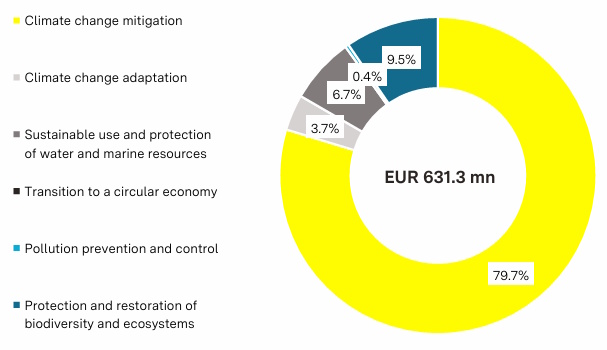
“Their project categories also go beyond the usual climate change mitigation, which is often considered to be low hanging fruit. If you look at what Land Baden-Württemberg has refinanced, it includes biodiversity and water and marine resources, where the requirements to achieve full Taxonomy alignment are much higher than, for example, renewable energy.”
Eligible Expenditure by EU Environmental Objective
Source: Baden-Württemberg Ministry of Finance
While the potential for such a diverse portfolio for Baden-Württemberg was always evident, being able to achieve Taxonomy alignment for a sufficient volume to achieve a benchmark-sized EuGB was a “cumbersome” year-on-year process, according to Emrich.
“We were close last year, at just over €400m,” he said, “and given the fact that we had some projects where we felt we could achieve the necessary documentation, and also some growth in projects that we knew were aligned, at the beginning of the year we said internally that we wanted to try to make this a EU Green Bond in 2026.
“It involved a lot of communication,” he added. “Our specialist, Stefan Hollnberger, worked with the project owners and did a great job in finding and convincing people to make some extra efforts to find the additional data we required.”
This enabled the state to achieve €631.3m of eligible expenditure and, compared to the challenges on this front, the other EuGB requirements were relatively straightforward to meet, said Emrich.
Baden-Württemberg was given an “excellent” assessment by Sustainable Fitch in its pre-issuance review.
The mandate for the EuGB was announced on 11 September, with launch to follow investor marketing.
Leads BNP Paribas, Crédit Agricole, Deutsche, DZ, LBBW and Nordea then opened books last Monday with guidance of the mid-swaps plus 24bp area for the €600m September 2036 issue, expected ratings Aaa/AA+/AAA (Moody’s/S&P/Scope). Demand topped €1bn, excluding joint lead manager interest, within 50 minutes, and after a little over an hour and a half, the spread was set at 23bp on the back of books above €1.45bn, including €110m of JLM interest. Demand ultimately reached more than €2bn, including the JLM interest.
“We’re very glad how it went,” said Emrich, “particularly when you look at how the week panned out.”
Of the 65 investors who participated, 20 were considered dark or medium green and 15 as dark green, with the remainder also having ESG mandates.
“Basically we had no one in the allocations who doesn’t have some kind of ESG mandate,” said Emrich, “which is different than some of the previous years when we had a simple green bond.”
While investors do not have mandates specifically requiring EuGBs, the standard means that such issuance naturally scores highly in investors’ internal ESG scoring, according to feedback received by Baden-Württemberg. Emrich also said that a supply-demand imbalance exists in EuGBs similar to that of the early days of the overall green bond market but which no longer applies to the broader product.
“We never would have tightened the one basis point in this market environment without the green label,” he added.
Emrich saw a greenium of a half to one basis point, taking into account the make-up of the book and its impact on execution, secondary levels of other Länder in the 10 year part of the curve, and the fact that the size, while a benchmark, did not reach the €1bn required by some accounts, thereby making tighter pricing more challenging.
Banks were allocated 65% of the issue, central banks and official institutions 13%, asset managers 11%, insurance companies and pension funds 10%, and others 1%. Germany took 52%, the Benelux 18%, France 10%, the Nordics 7%, the UK and Ireland 4%, other Europe 8%, and the Middle East and Africa 1%.
Having inaugurated its EuGB issuance, Baden-Württemberg will now stick with the standard, and will work towards growing its eligible portfolio.
“We had to take out some very nice projects,” said Emrich. “Some nice biodiversity projects in organic farming that had to go, for example, because agriculture is not eligible in the Taxonomy. And we took out freshwater infrastructure, which would otherwise have made a lot of sense in the water environmental objective, because we could not document water loss as required under the do no significant harm part – since we have new pipes with new technology, there isn’t a problem with water loss, so nobody thought to collect the data.
“The hope is that we can include some of these good sustainable projects again, either as a result of the work being done to make the Taxonomy less bureaucratic – which may mean that the metric we cannot document is removed – or because we somehow manage to document it. On the other hand, we have some projects where we simply expect more expenditure this year than last, and so the portfolio might grow in that way.”